See Our Contract Farming Services
If you already have your soil and water analysis and would simply like to opt for the detailed project report (DPR) to avail government subsidies on the cost of your

If you already have your soil and water analysis and would simply like to opt for the detailed project report (DPR) to avail government subsidies on the cost of your




We are a team of agricultural consultants dedicated to providing top-notch services related to agriculture, horticulture, organic farming, landscaping, kitchen gardening, bio-fertilizers, plant protection materials, and other agriculture input providers. With a tagline of "helping mankind through agriculture," we believe in using our expertise and knowledge to contribute to the growth and development of the agricultural industry.

In India, there are different models of contract farming practiced. The models which are to be followed totally depend upon the buyer. Before moving towards the types of contract farming, one thing is very much important to understand that in India there is no single type or set of contract farming is practiced. In the majority of cases it is mixed of all types. The types of contract farming described below are decided by the Food and Agriculture Organization (FAO). In some of the countries the exact model is followed while in countries like India they are customized according to the need of buyer and seller.
In India, there are different models of contract farming practiced. The models which are to be followed totally depend upon the buyer. Before moving towards the types of contract farming, one thing is very much important to understand that in India there is no single type or set of contract farming is practiced. In the majority of cases it is mixed of all types. The types of contract farming described below are decided by the Food and Agriculture Organization (FAO). In some of the countries the exact model is followed while in countries like India they are customized according to the need of buyer and seller.
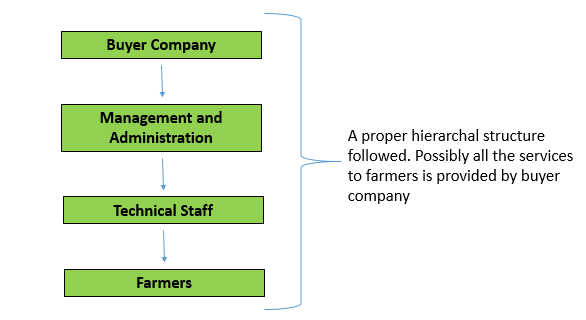
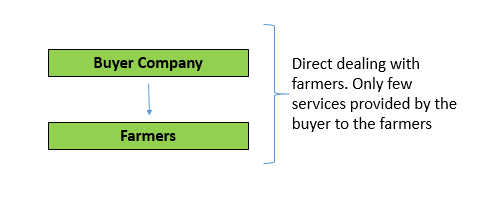
In this type of contract farming, there is one centralized processor or buyer who is the only entity involved in the contract with farmers. It is centrally monitored and managed by the buyer. All the services whether it is technical guidance or advisory is provided by them and no other stakeholder or entity is involved. The services by the buyer company may range from providing just good quality seeds or the extreme opposite by providing all the required services like land preparation, seedlings, Agro-chemicals and even harvesting services. Moreover, in this type of contract farming, the buyer procures from many small farmers rather than buying from a few large farmers. The model is better understood seeing the below figure.
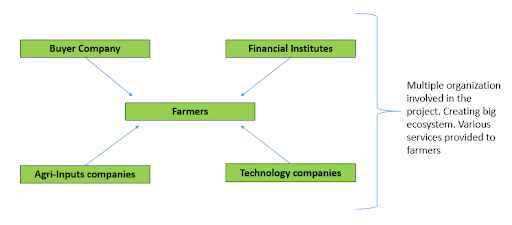
Unlike the centralized model where the activities were centrally monitored and managed by a single entity, in the multipartite model the different entities and companies jointly take part with the farmers. The services provided by the farmer will come from different organizations according to their expertise. For example, farmers will be provided financial services from the financial institutes who are part of the contract, they will be getting agri-inputs from the agri-inputs company, while specific technology needed at farm level will be provided by the tech company. And at the end, the harvested produce is taken by the main buyer company.
As the name suggests, it is an informal model. This model is followed by single entrepreneurs or small companies who enter informal contracts with the farmers for a particular season. This is majorly done for fresh vegetables and fruits. Unlike the rest of contracts which are long term, the informal model is not for long. It could be for a single season or two. Generally the duration of such a contract depends upon the need and resource arrangement by the entrepreneurs or small companies.
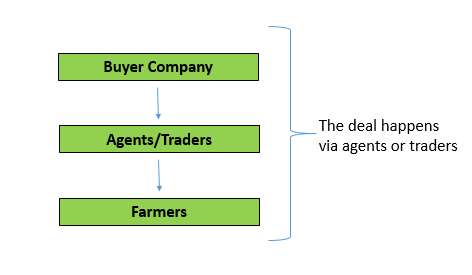
In the intermediary model there is involvement of intermediaries like agents or traders in the contract. In such cases, the company may not be directly in contact with the farmers. Agents/traders are in direct contact with the farmers. These intermediaries are sort of external representatives of the final buyer company.
The harvested produce will be taken by the agents which will eventually be given to the buyer company. The intermediary model is practiced by such companies who do not want the extra work of managing the farmers and providing the services to them. Hence,
Contract farming comes with various benefits not only to farmers but also to the buyer companies. Let us see some of the benefits of contract farming:
